How to Verify a Plot Before Buying in Telangana: The 21-Point Checklist
Twenty-one checks we run on every open plot in Telangana, in the order that kills bad deals fastest: seller and title, approvals, land character and zoning, then survey, access and dues, with where to check each and what failure means.

- Run cheap screening checks before paying any token, and keep the token small and refundable in writing
- Confirm the layout permit number and final plan directly with HMDA, DTCP or the municipality, not from photocopies
- Check your plot is released and not in the developer's mortgaged schedule, commonly around 15% of saleable area
- Trace the parent survey number for assigned, government, 22-A, lake FTL and buffer issues
- A licensed survey against the layout plan catches short areas, encroachments and narrow roads
| What | Indicative range | Note |
|---|---|---|
| Official fees for EC and certified copies | ₹2,000 – ₹10,000 | indicative, Oct 2026, verify |
| Licensed surveyor, plot measurement | ₹10,000 – ₹25,000 | indicative |
| Independent advocate's legal opinion | ₹15,000 – ₹40,000 | indicative, scope-dependent |
| Public notice in newspapers | ₹5,000 – ₹15,000 | indicative |
| Stamp duty + transfer duty + registration fee | ≈ 7.5% of market value | approximate, verify current rates at the SRO |
Ranges reflect recent transactions and advisor observation as of 2026-10. Always verify against the sub-registrar market value and the specific parcel.
Knowing how to verify a plot before buying is the single skill that separates a good plot purchase in Telangana from a decade-long court case. Open plots are the most traded and the most disputed asset class around Hyderabad. The same 200 sq yd can be sold twice, sit inside a lake buffer that nobody mentioned, lie in a gram panchayat layout dressed up as "HMDA", or be one of the plots a developer mortgaged to the authority and never released. None of this shows on the ground. A plot with fresh boundary stones, a neat arch and a tarred layout road can still be unbuildable or unsaleable. This guide sets out the 21 checks we run on every plot, in the order that saves the most time and money, with where to check each item and what a failure actually means for you.
We are property advisors, not advocates. The checklist below is how we screen plots and brief the advocate who issues the final legal opinion. Portal names, fees and rules are as of October 2026; verify on the day.
Who this checklist is for
It is for anyone buying an open plot in Hyderabad, the HMDA region or a Telangana district town: a family buying a site to build a home, an investor buying in a growth corridor such as Maheshwaram, Shadnagar or Kollur, or an NRI buying through a power of attorney. It assumes the plot is in a residential layout. If you are buying agricultural land, the logic is similar but the records differ; see our separate step-by-step guide to buying agricultural land in Telangana.
Why plot verification matters more than flat verification
An apartment buyer in a RERA-registered project benefits from a builder who has already assembled the land, obtained permissions and been examined by lenders. A plot buyer usually deals with an individual seller or a layout developer, and there is no building permission, occupancy certificate or bank tie-up to act as an external check. The risk lands entirely on you.
The common failures fall into four families. Title failures: the seller does not own what they are selling, or someone else also has a claim. Approval failures: the layout or plot is not what it is presented as, so you cannot get building permission or a loan. Land-character failures: the land is government, assigned, prohibited, lake, nala or otherwise restricted. Physical failures: the plot on the ground is not the plot on paper, or it has no lawful access. The 21 points are grouped to test each family in turn.
How verification works in Telangana: the records and portals
Before the checklist, it helps to know where the evidence lives.
- Registration and Stamps Department (IGRS). Every registered sale deed, mortgage, gift and agreement since computerisation can be searched through encumbrance certificates and certified copies on registration.telangana.gov.in. Market values for stamp duty and the prohibited properties list are also published there.
- Revenue records (Bhu Bharati, formerly Dharani). These hold the record of rights for agricultural land: survey numbers, pattadars and land classification. For a plot, they tell you what the parent land was before the layout and whether any part of it is government, assigned or prohibited.
- Planning authorities. HMDA approves layouts in the metropolitan region and publishes master plans and approved layouts at hmda.gov.in. DTCP does the same outside HMDA. Municipal and GHMC offices hold LRS and tax records.
- TS RERA. New plotted developments above the statutory thresholds must be registered with the Telangana Real Estate Regulatory Authority at rera.telangana.gov.in.
- Courts and irrigation records. Litigation searches, lake full tank level maps and nala alignments sit with courts, the irrigation department and the planning authorities.
The 21-point plot verification checklist
Run these in sequence. The early points are cheap and quick and kill most bad deals before you spend money on surveyors and advocates. Each point lists where to check and what a failure means.
Stage 1: Seller and title (points 1–6)
- Seller identity matches the title deed. The person signing must be the person named as owner in the latest registered deed, with matching name, father's name and address. Where to check: original sale deed against Aadhaar, PAN and an in-person meeting. What failure means: a risk of impersonation; do not proceed until resolved.
- All owners and heirs are joining. If the owner has died, every legal heir must sign or have released their share by registered deed. Where to check: death certificate, family member or legal heir certificate, release deeds. What failure means: a non-joining heir can later challenge the sale and claim a share.
- Power of attorney is valid and registered. If an agent is signing, the GPA must be registered, specific to this plot and the principal must be alive. Where to check: certified copy of the GPA from IGRS; a recent life confirmation of the principal. What failure means: a sale under a revoked GPA, or after the principal's death, is void.
- Title chain of at least 30 years. Every transfer from the parent agricultural land through the layout to the current seller must be unbroken. Our guide to link documents and title chains explains how to read one. Where to check: link documents, with certified copies from the SRO. What failure means: a gap means someone in the chain may not have had title to pass.
- Encumbrance certificate for 30 years. The EC should show only the transactions in the chain and no live mortgage, agreement or attachment. Our encumbrance certificate guide walks through it. Where to check: online EC on IGRS, cross-checked by survey number and plot number. What failure means: an undisclosed mortgage or prior sale agreement becomes your problem after registration.
- No prior sale or agreement to someone else. Double sales are common in plots. Where to check: EC searched by seller name as well as property, plus a public notice in local newspapers inviting objections. What failure means: a competing buyer with an earlier registered document can defeat your claim.
Stage 2: Approvals (points 7–11)
- Layout approval and layout permit number. The layout must be approved by HMDA, DTCP or the municipal authority, not merely by a gram panchayat. Our guide to HMDA, DTCP and gram panchayat layouts sets out the difference. Where to check: the approval letter and final layout plan, verified on the authority's website or office. What failure means: no building permission, no bank loan and resale only at a discount.
- Your plot number exists in the final approved plan. Developers sometimes sell open spaces, park areas or road strips as plots, or renumber plots after approval. Where to check: the final approved layout plan, matching plot number, dimensions and orientation. What failure means: a plot carved from public space can be reclaimed without compensation.
- The plot is released, not mortgaged. Layout developers mortgage a share of plots to the authority, commonly around 15% of saleable area, until roads, drains and utilities are completed. Where to check: the mortgage deed schedule and the release proceedings from HMDA or DTCP. What failure means: a mortgaged plot cannot be registered or built on until released, and if the developer defaults, it may never be.
- LRS status if the layout was unapproved. A plot in an unauthorised layout may have been regularised under the Layout Regularisation Scheme. Where to check: LRS proceedings issued by the authority, with fees fully paid. What failure means: an application pending or rejected means no building permission and an uncertain future.
- RERA registration for new layouts. New plotted developments above about 500 sq m or eight plots must be registered with TS RERA. Where to check: the project search on the TS RERA portal; confirm validity and quarterly updates. What failure means: an unregistered new layout is a regulatory breach and removes RERA remedies if the developer fails to deliver.
Stage 3: Land character and zoning (points 12–16)
- Master plan land use is residential. Where to check: the HMDA or local master plan and a land-use certificate. What failure means: land in a conservation, recreational, industrial or green zone cannot carry a house regardless of what the layout says.
- Not on the Section 22-A prohibited list. Government land, assigned land, endowment, wakf and certain other lands are notified as prohibited from registration. Our guide to assigned land and Section 22-A prohibited properties explains the categories. Where to check: the prohibited properties list on IGRS and the revenue record of the parent survey number. What failure means: the SRO may refuse registration, and a deed that slips through can be cancelled.
- Parent land was not assigned, ceiling-surplus or inam land sold irregularly. Where to check: pahani history, 1B and the old revenue registers for the parent survey number. What failure means: assigned land cannot be lawfully sold under the POT Act and can be resumed by the government.
- Parent land was converted from agricultural use. Where to check: NALA conversion proceedings or the conversion recorded in the layout approval. What failure means: unconverted land cannot lawfully be used as a residential plot, and conversion fees and penalties may fall on you.
- Outside lake FTL, buffer and nala zones. Lakes carry buffers of up to 30 m from the full tank level for larger water bodies and narrower buffers for smaller tanks and nalas. Our guide to lake FTL, buffer zones and HYDRAA covers the stakes. Where to check: FTL maps, irrigation department records and the master plan. What failure means: no permission, and since 2024 an active demolition risk.
Stage 4: Physical and financial (points 17–21)
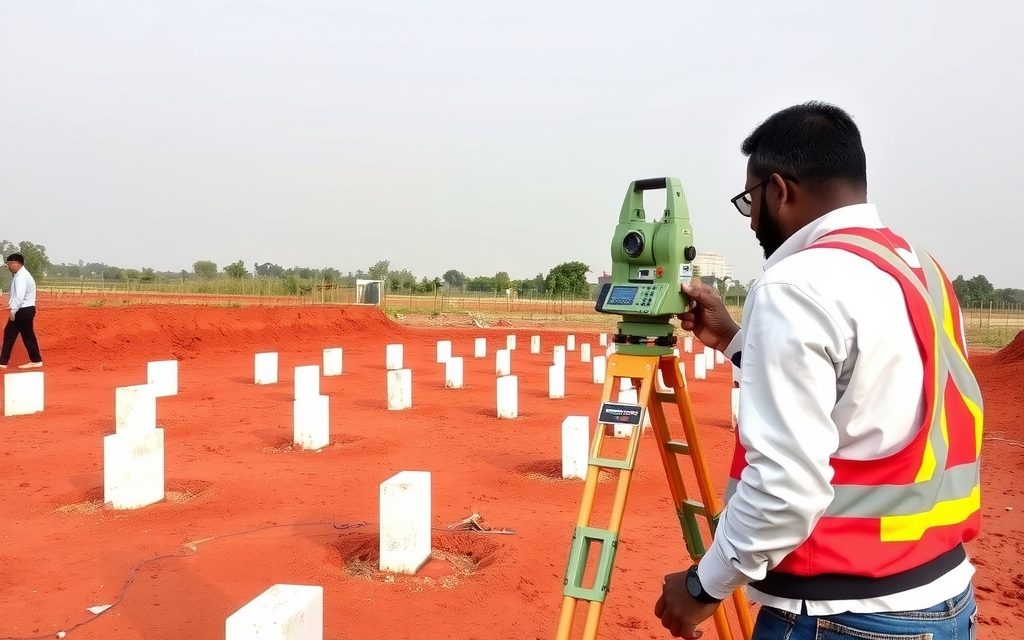
- Boundaries and area match the documents. Where to check: a licensed surveyor's measurement against the layout plan and the FMB or tippon of the parent survey number; see our guide to land surveys, FMB and boundaries. What failure means: a shortfall in area, encroachment by a neighbour or a plot that sits partly in the next survey number.
- Lawful access on a road of the approved width. Where to check: the layout plan and the road on the ground, measured. What failure means: a narrower road reduces permissible height and can block access entirely if it is private land.
- Physical possession is with the seller and free of occupation. Where to check: site visits at different times, conversations with neighbours and the layout association. What failure means: evicting an occupant or a rival claimant can take years.
- No litigation, attachment or acquisition. Where to check: court case searches against the seller and survey number, and road widening, RRR or other acquisition notifications. What failure means: a pending suit binds you as a later buyer; an acquisition notification can freeze or take the land.
- Taxes, dues and market value are in order. Where to check: vacant land tax receipts, the IGRS market value for stamp duty and the seller's tax status for TDS. What failure means: arrears transfer with the plot; an NRI seller triggers much higher TDS under Section 195, which the buyer must deduct.
The document pack to ask for on day one
A serious seller can produce most of these within a day or two. Delay or reluctance on any of them is itself information.
- Copy of the seller's registered sale deed, and every earlier deed back to the parent agricultural land.
- Layout approval letter, layout permit number and the final approved layout plan with the plot highlighted.
- Release proceedings covering the plot, or confirmation that the plot was never in the mortgaged schedule.
- LRS proceedings if the layout was regularised rather than approved at the outset.
- TS RERA registration number for a new layout.
- Encumbrance certificate the seller has already pulled, which you will re-pull independently.
- Latest vacant land tax receipt and any association or maintenance dues statement.
- Seller's PAN, Aadhaar and, for an NRI seller, passport and residency details for TDS.
- Any GPA, release deed, legal heir certificate or court order that forms part of the chain.
Copies are enough for screening. Originals must be seen before registration, and the originals of every link document should be handed over to you at registration unless they cover other properties, in which case certified copies and an undertaking to produce the originals are the norm.
Step-by-step: running the checklist, with timelines and costs
| Stage | What happens | Typical time | Indicative cost |
|---|---|---|---|
| Screening | Points 1, 7, 8, 12, 13 and 16 from copies the seller shares | 1–3 days | Nil to a few thousand rupees |
| Records pull | EC, certified copies, layout and release records, LRS, RERA | 3–10 days | ₹2,000 – ₹10,000 in official fees and copies |
| Survey | Licensed surveyor fixes boundaries, measures road | 2–7 days | ₹10,000 – ₹25,000 |
| Legal opinion | Advocate reviews the full file and issues a written opinion | 5–10 days | ₹15,000 – ₹40,000 |
| Public notice | Newspaper notice inviting objections | 7–15 days running in parallel | ₹5,000 – ₹15,000 |
| Registration | Stamp duty, transfer duty and registration fee at the SRO | 1 day with slot | About 7.5% of market value; verify current rates |
For duty components and how market value is fixed, see our stamp duty and registration charges guide. Allow three to four weeks between token and registration for a clean plot. Sellers who push for registration within a week usually have a reason.
A worked example from the Maheshwaram belt
A Hyderabad buyer shortlists a 240 sq yd plot in a layout near Maheshwaram, marketed as "HMDA approved, ready to register" at ₹22,000 per sq yd, or ₹52.8 lakh. The seller asks for a ₹5 lakh token.
Screening takes two days. The layout permit number checks out with HMDA, the master plan shows residential use, and the parent survey number is not on the prohibited list. So far, so good. The buyer pays a ₹1 lakh token under a short agreement that makes it refundable on a negative legal opinion.
The records pull finds the problem. The release proceedings issued by HMDA cover most plots, but the buyer's plot number falls in the mortgaged schedule. The developer has completed the roads but not the drainage and power works, so the mortgaged plots are not yet released. The seller, a first-generation buyer from the developer, had not realised this. Registration would have been either blocked or, worse, completed on a plot the authority still holds as security.
The buyer has three options: wait for release, which depends on the developer finishing works; switch to a released plot in the same layout; or walk away. They choose a released plot of 220 sq yd two rows away at the same rate, ₹48.4 lakh. The survey finds the plot 3 sq yd short on the ground because a neighbour's compound wall has crept over, which the developer fixes before registration. Total verification spend comes to about ₹45,000. Duty and fees come to about ₹2.9 lakh, and TDS does not apply because the price is under ₹50 lakh. For context on the corridor, see our page on open plots in Maheshwaram.
What to do when a point fails
Not every failure is fatal. Part of the skill is telling a curable defect from a structural one.
Usually curable before registration
A missing release deed from one legal heir, a gap in tax payments, a plot that is short by a few square yards because of a neighbour's wall, an old mortgage that was repaid but never formally closed, or a GPA that needs to be replaced by the principal signing in person. In each case, the fix is for the seller to cure the defect at their cost before you register, and your agreement should say so with a date. Hold back a meaningful part of the price until the cure is documented.
Curable only with time and uncertainty
A plot in the mortgaged schedule awaiting release, an LRS application still pending, or an approach road whose widening is planned but not done. These depend on someone else, usually the developer or an authority. Unless the price reflects the wait and the risk, switch plots.
Structural: walk away
Parent land that is assigned, government, endowment or wakf; a plot inside a lake FTL or buffer; a master plan zoning that does not permit housing; a gram panchayat layout with no route to approval; an earlier registered sale to someone else; or a pending suit over title. No discount compensates for these, because the problem travels with the land to every future buyer, including the one you will eventually want to sell to.
Mistakes we see in practice, and the fix
- Paying a large token before screening. Fix: keep it small and refundable in writing until the legal opinion is in.
- Trusting a photocopy of the layout approval. Approvals are forged and recycled from neighbouring layouts. Fix: verify the permit number and plan with the authority directly.
- Checking the EC only by plot number. Older entries are often indexed by survey number or seller name. Fix: search all three.
- Relying on the bank's legal report as complete. Fix: treat it as a second opinion, not the only one.
- Skipping the survey because the stones look right. Fix: always measure against the layout plan and the parent survey map.
- Ignoring the parent land. A perfect layout on assigned or lake land is still defective. Fix: trace the parent survey number through revenue records.
- Buying from a GPA holder without seeing the principal. Fix: confirm the principal is alive and the GPA unrevoked, or have the principal join the deed.
- Forgetting TDS on an NRI seller. Fix: get a CA involved before you agree the payment schedule; a lower-deduction certificate may be possible.
A note for NRIs verifying from abroad
NRIs and OCI cardholders can buy residential plots in approved layouts in Telangana, but not agricultural land or farm plots, so point 7 and point 15 carry extra weight for you: a "plot" that is really unconverted farm land is not just a weak investment but a FEMA problem. Most of the records in this checklist can be pulled online or through a local representative, but two points need a physical presence you trust: the survey and the possession check. Do not let the seller's agent be that presence. Register a specific power of attorney in favour of a family member or advisor for the purchase only, pay from your NRE or NRO account so the funds trail is clean, and keep scanned copies of every record in one place for the eventual resale and repatriation.
How NRR Estates handles plot verification for clients
Every plot we recommend has been through this checklist before it reaches you. For plots you find yourself, we run the screening within a couple of days and tell you plainly whether it is worth spending on a survey and legal opinion. We pull the records, brief an independent advocate, arrange a licensed surveyor and walk the site with you, then put our findings in writing in plain English, including the points that are fine, the points that need fixing before registration and the points that should end the deal. For NRIs, we run the whole sequence remotely, with video walkthroughs and scanned records, and coordinate registration through your power of attorney. Our fees are disclosed before any commitment, and we would rather lose a deal than let a client register a plot that fails these checks.
Plot verification questions we are asked
What documents should I check before buying a plot in Telangana?
At minimum: the seller's registered sale deed and every link document back to the parent agricultural land, a 30-year encumbrance certificate, the layout approval and final layout plan with the plot number, release proceedings for the plot, LRS proceedings if applicable, TS RERA registration for new layouts, the master plan land use, the latest vacant land tax receipt, and the seller's identity and tax details. Add the revenue records of the parent survey number to rule out assigned, government or prohibited land.
How do I check if a plot is HMDA approved?
Ask for the layout permit number and the final approved layout plan, then verify both with HMDA directly through its website or office rather than relying on a brochure or photocopy. Confirm that your plot number, dimensions and orientation appear in that final plan, that the plot is not an open space or road strip, and that it has been released from the developer's mortgage. Approvals are sometimes copied from neighbouring layouts, so match the survey numbers in the approval with your title deeds.
What is a mortgaged plot and why does it matter?
When HMDA or DTCP approves a layout, the developer mortgages a share of plots, commonly around 15% of saleable area, to the authority as security for completing roads, drains, water and power works. Those plots are released only once the works are certified. Until then, a mortgaged plot should not be sold or built on. If the developer never completes the works, release may never happen. Check the mortgage schedule and release proceedings before paying for any plot in a newer layout.
How many years of encumbrance certificate should I check?
We recommend 30 years, matching the link document chain. Online ECs on the Telangana Registration and Stamps portal cover the computerised period, and older entries may need a manual search at the SRO. Search by survey number, plot number and the seller's name, because older records are often indexed differently. The EC should show only the transactions in your chain, with any mortgages closed. An undisclosed agreement, mortgage or attachment becomes the buyer's problem after registration.
How do I know if a plot is in a lake buffer zone?
Check the full tank level maps and buffer boundaries maintained by the irrigation department and planning authorities, and the master plan. Larger lakes carry buffers of up to 30 m from the FTL, with narrower buffers for smaller tanks and nalas. The ground often gives no clue, especially in a dry year. Since 2024, HYDRAA has demolished structures in FTL and buffer areas around Hyderabad, so treat this as a walk-away check rather than a negotiation point.
Can I buy a plot from a GPA holder?
You can, but it needs extra care. The general power of attorney must be registered, cover this specific plot and the act of sale, and remain unrevoked, and the principal must be alive on the date of registration, because a GPA ends on death. Pull a certified copy of the GPA from the SRO and confirm the principal's status independently. Where possible, ask the principal to join the sale deed directly, which removes most of the risk.
Is a bank's legal clearance enough to buy a plot?
No. A bank's legal and technical panel checks enough to protect the bank's security, typically the title chain, EC and layout approval over a defined period. It may not trace the parent land's history, check lake buffers in detail, measure the plot on the ground or search litigation thoroughly. Treat a positive bank report as a useful second opinion and a negative one as a strong warning, but commission your own legal opinion and survey.
How long does plot verification take?
For a clean plot, three to four weeks from token to registration is realistic. Screening takes one to three days, pulling records three to ten days, a licensed survey two to seven days, and an advocate's written opinion five to ten days, with a newspaper public notice running in parallel. Delays usually come from missing link documents or unreleased plots. Sellers who insist on registering within a week often have something they would rather you did not check.
Related guides

What a Telangana encumbrance certificate shows and what it misses, why advocates search 30 years, how to run an EC search online through IGRS, how to read each entry, and the nil EC traps that catch buyers.
What HMDA, DTCP and so-called panchayat layout approvals really mean in Telangana: jurisdictions, LP numbers, mortgaged plots and release letters, LRS, bank loan eligibility, online verification and red flags.

A sale deed is only as good as the deeds behind it. Why lawyers trace at least 30 years to a root of title, how partitions, GPA sales, wills and decrees fit in, and what a title opinion actually checks.

Assigned land, Bhoodan, endowment, wakf and government land cannot be sold to private buyers. How the POT Act and Section 22-A work, how to search a survey number, and what happens if you buy by mistake.

Plot loans finance less, cost more, run shorter and give no tax relief on their own. Which Telangana plots banks will finance, how LTV and construction deadlines work, and when a composite loan is the smarter route.

Approved open plots in Maheshwaram sit between the airport, the Raviryal electronics cluster and the Srisailam highway. Indicative October 2026 prices, approvals, legal checks and the lessons of the Fab City years.

Approved plots in the Bengaluru-highway town 30-odd km beyond the airport: town, NH-44 and RRR pockets, indicative HMDA and DTCP prices, frontage rules and what to verify before you pay.

Kollur has its own ORR interchange and sits between Tellapur, Mokila and Velimela, with HMDA plots usually 15–25% below Tellapur. Indicative rates, approval checks, pricing traps and the investment case.