Agriculture & Farm Land in Bodhan, Nizamabad
Black-soil paddy and former cane land in the Nizam Sagar command, 25 km west of Nizamabad. Indicative per-acre prices, how to judge canal water, the sugar factory's legacy and the Telangana title checklist.
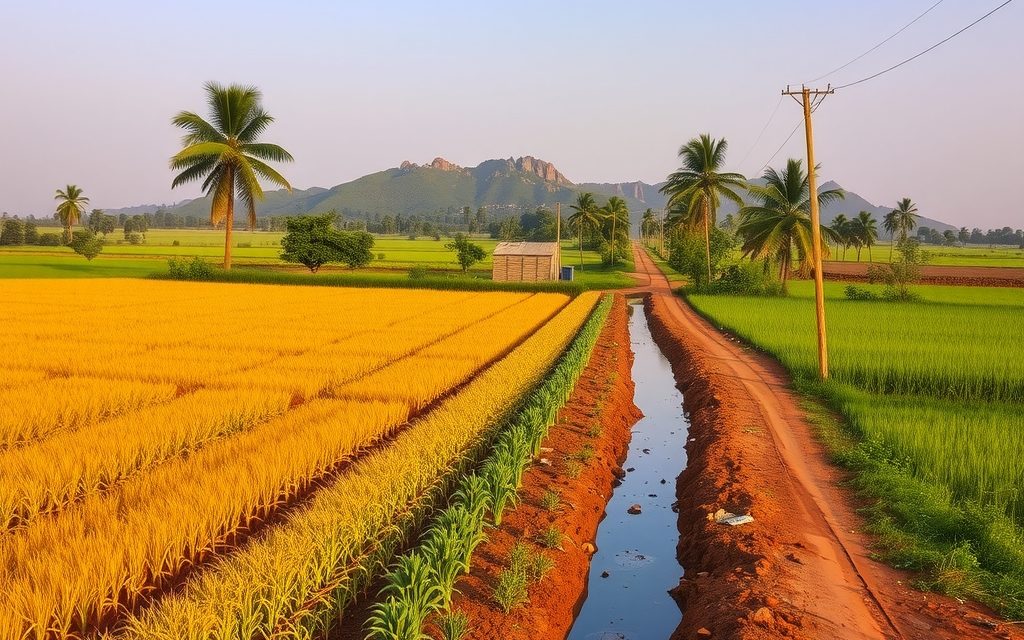
- About 25 km west of Nizamabad and roughly 195–210 km from Hyderabad via NH-44
- Inside the Nizam Sagar canal command; borewells in the ayacut often strike water at 80–250 ft
- Deep black cotton soil growing paddy, soybean, maize, turmeric and some sugarcane
- Canal-command land typically ₹25 L – ₹45 L per acre as of October 2026; parcels mostly 1–5 acres
- Agricultural land registers at the mandal Tahsildar office; converted land and plots at the jurisdictional SRO
| What | Indicative range | Note |
|---|---|---|
| Bodhan town fringe within about 5 km, BT road frontage | ₹70 L – ₹2 Cr per acre | indicative, Oct 2026 |
| Nizamabad–Bodhan road frontage outside town | ₹80 L – ₹2.2 Cr per acre | indicative, Oct 2026 |
| Nizam Sagar canal land, good reach, Kotagiri–Rudrur–Varni side | ₹25 L – ₹45 L per acre | indicative, Oct 2026 |
| Tail-end canal or single-bore black-soil land | ₹18 L – ₹32 L per acre | indicative, Oct 2026 |
| Rainfed uplands, interior villages | ₹10 L – ₹20 L per acre | indicative, Oct 2026 |
| Farm plots in small fenced ventures near town | ₹1.2 L – ₹3 L per gunta | indicative, Oct 2026 |
Ranges reflect recent transactions and advisor observation as of 2026-10. Always verify against the sub-registrar market value and the specific parcel.
Bodhan grew up around a sugar factory and a canal. The Nizam Sagar main canal reached this corner of Nizamabad district in the 1930s, the Nizam Deccan Sugars mill at Shakkarnagar followed, and for most of the twentieth century the black cotton soil between Bodhan, Kotagiri, Rudrur and Varni was planted wall to wall with sugarcane and paddy. The factory has been shut since 2015 and the cane has thinned out, but the canals, the soil and the farming culture are still there. Anyone looking at agriculture land in Bodhan today is buying into a mature irrigated belt that has had to reinvent its cropping, not into raw countryside. This guide explains what the land is like village by village, what it costs per acre as of October 2026, how to judge whether a parcel really gets Nizam Sagar water, and how registration works at the mandal Tahsildar office.
We use "Bodhan" in the way local buyers do: the town and its mandal, plus the Nizam Sagar command villages that look to Bodhan for markets, banks and the revenue division office. That takes in Renjal, Navipet, Yedapally, Kotagiri, Rudrur, Varni, Chandur and Mosra, with Banswada in Kamareddy district just to the south. Older deeds in these villages often carry the same mandal and district names they do today, which makes title tracing simpler than in districts that were split in 2016, but you still need the full chain.
Why Bodhan is worth a look for farm land
Bodhan offers something that is getting rare within a half-day's drive of Hyderabad: deep, water-holding black soil inside a long-established canal command, priced on what it grows rather than on what a layout developer might do with it. In most years the canal villages take two crops, and the borewells that sit inside the ayacut benefit from almost a century of seepage and recharge. Land like this rarely changes hands in big blocks, which keeps the market honest.
The second reason is the price gap. Comparable canal land closer to Hyderabad, or on NH-44 around Armoor and Dichpally, has moved up faster because of highway frontage and plotting demand. Bodhan sits off the national highway, about 25 km west of Nizamabad, and its interior villages are still traded mostly between farming families. For a buyer who wants productive, leasable land and is patient about appreciation, that is the attraction.
The third reason is a local buyer base that never left. Bodhan has a large Gulf-remittance community and many families who moved to Hyderabad but kept their roots here. They buy land in their own villages when it comes up, which gives you a real resale market. It also means good parcels are often sold to relatives or neighbours before an outsider hears of them, so local contacts matter.
Location and roads: reaching Bodhan from Hyderabad and Nizamabad
Most people drive up NH-44 through Kamareddy to Nizamabad and then head west on the Nizamabad–Bodhan road, a total of roughly 195 to 210 km from central Hyderabad and about four hours from Gachibowli in normal traffic. A slower alternative runs through Medak and Banswada and suits buyers inspecting villages on the southern side of the command. Bodhan has a railway station on the branch line from Nizamabad, though for land visits a car is far more practical.
- Nizamabad: about 25 km east, the district headquarters with hospitals, the collectorate, the main market yard and the turmeric trade.
- Banswada: about 30 km south, in Kamareddy district, another Nizam Sagar command town.
- Nizam Sagar dam: roughly 45 to 55 km south by road, on the Manjira in Kamareddy district.
- Kandakurthi: in Renjal mandal north of Bodhan, where the Manjira meets the Godavari.
- Basar: the Gnana Saraswati temple town across the Godavari in Nirmal district, under an hour north.
- Maharashtra border: close to the west along the Manjira, with Degloor and Dharmabad the nearest towns across it.
Within the belt, the roads that decide price are the Nizamabad–Bodhan road, the Bodhan–Banswada road through Kotagiri and Rudrur, the road north to Renjal and Navipet, and the roads west toward the Manjira and the border. Away from these, village roads in black soil turn soft in the monsoon. Before you settle on a parcel, ask how a sugarcane lorry or a paddy harvester gets in during August, because that is the honest test of access.
The Nizam Sagar command: how to judge whether a parcel really gets water
The Nizam Sagar project, built on the Manjira during the Nizam's rule and completed in the early 1930s, is one of the oldest major irrigation systems in Telangana. Its main canal runs north from the dam through Banswada and Varni toward Bodhan, Kotagiri, Rudrur and on to Nizamabad, feeding a dense web of distributaries and minors. This ayacut is the reason Bodhan exists as a farm town.
The catch is that the reservoir has lost capacity to siltation over the decades, and its inflows depend on rain in the upper Manjira catchment in Maharashtra and Karnataka and on how much water is held upstream at Singur, which also supplies Hyderabad. In good monsoon years the command gets two full crops; in poor years the second crop shrinks to the villages near the head of the system and those with strong borewells. Proposals to supplement Nizam Sagar with water lifted from the Godavari have been discussed for years, but we do not price any of that into an offer.
Reading a canal year
When a seller says the land is "canal land", ask four questions. Which distributary and which minor serve the survey number? Does a working field channel reach the parcel, or does water have to pass through a neighbour's field? In how many of the last five years did the land take a second, yasangi crop on canal water? And when water is short, does this village sit near the head or the tail of its minor? Neighbours and the local lift or water-user committee will tell you more than any document.
Groundwater
Inside the command, borewells commonly strike water at 80 to 250 feet thanks to canal recharge, and older open wells still hold water in many villages. On the uplands outside the ayacut, 300 to 500 feet is more typical and yields are less certain. A parcel with both canal access and a reliable bore is worth noticeably more than one that depends on either alone, and we price it that way.
Black soil and what grows here now
Bodhan's soil is predominantly deep black cotton soil, heavy and moisture-retentive, cracking in summer and turning sticky in the rains. It is excellent for paddy, sugarcane and soybean and good for maize and turmeric where drainage is managed. Patches of lighter, mixed soil appear on the higher ground toward the uplands, and alluvial strips line the Manjira and the Godavari.
For decades sugarcane defined the landscape. Since the Shakkarnagar factory stopped crushing, much of the cane area has shifted to paddy in both seasons where water allows, to soybean and maize in the kharif on drier fields, and to turmeric in pockets, following the Armoor and Nizamabad trade. Some farmers still grow cane and send it to mills further away, including across the border in Maharashtra, but transport cost eats into the margin. Orchards are not the main story here, though mango, sweet lime and guava gardens appear on lighter soils and near the town.
For a buyer, the practical point is that the land is flexible. Good black soil with canal water and a bore can switch between paddy, cane, soybean and vegetables as prices move, which is part of what keeps its value steady.
A sugar town after its factory: what the closure changed for land
Nizam Deccan Sugars at Shakkarnagar was started by the Nizam's government in the late 1930s and was for a long time one of the largest sugar mills in Asia. It anchored Bodhan's economy, created the township, and gave cane farmers an assured buyer at the end of their own canal. A partial privatisation in the early 2000s was followed by financial trouble, and the factory stopped crushing in 2015. Successive state governments have spoken about reviving it, and committees have studied the question, but as of October 2026 we treat a revival as a possibility rather than a plan.
For land prices the effect was real but not catastrophic. Cane land lost its premium, some families sold during the difficult years after the closure, and leases fell in villages that had depended on cane. Paddy, soybean and turmeric absorbed most of the land, and the canal water kept values anchored to production. If the mill is revived, cane land near Shakkarnagar would regain some of its old advantage; if not, the belt continues as a paddy and mixed-crop command. Either way, we would never advise a client to pay extra for a parcel because "the factory is reopening".
The factory also left behind land-use questions worth checking. Some land around Shakkarnagar belonged to or was leased by the company, and a few survey numbers have long-standing disputes. If a parcel is near the factory township, ask for specific confirmation that it is private patta land with no company claim.
Agriculture land in Bodhan: indicative price bands per acre
These ranges reflect recent transactions and advisor observation as of October 2026. They are indicative only; individual parcels move outside them for frontage, shape, water and title. Prices are per acre except for farm plots, which are quoted per gunta (40 guntas make an acre).
| Parcel type and location | Indicative range | What drives it |
|---|---|---|
| Bodhan town fringe within about 5 km, BT road frontage | ₹70 L – ₹2 Cr per acre | Plotting and commercial potential, municipal proximity |
| Nizamabad–Bodhan road frontage outside town | ₹80 L – ₹2.2 Cr per acre | Frontage, depth, distance from Nizamabad |
| Nizam Sagar canal land, good reach, Kotagiri–Rudrur–Varni side | ₹25 L – ₹45 L per acre | Working field channel, two crops, bore backup |
| Tail-end canal or single-bore black-soil land | ₹18 L – ₹32 L per acre | Second-crop reliability, bore yield |
| Manjira or Godavari-side land toward Renjal and the border | ₹18 L – ₹35 L per acre | Alluvium and recharge versus flood history |
| Rainfed uplands, interior villages | ₹10 L – ₹20 L per acre | Access, soil depth, distance from canal |
| Farm plots in small fenced ventures near town | ₹1.2 L – ₹3 L per gunta | Plantation, fencing, approach road |
Two things the table cannot show. A field channel that crosses a neighbour's land is worth less than one that reaches your boundary directly, because water disputes start there. And land on the town side of Bodhan has begun to price on future plotting, so a cheap interior parcel is often simply correctly priced farmland rather than a bargain. Bodhan's bands sit close to the Nizam Sagar command figures in our Nizamabad district farm land guide, a little below the turmeric belt around Armoor.
Village belts around Bodhan, compared
Kotagiri, Rudrur and Varni
The heart of the canal command south of Bodhan. Deep black soil, dense distributaries and some of the best second-crop records in the belt. This is where most clients who want productive, leasable paddy land end up, and where good parcels sell quietly.
Bodhan town fringe and Shakkarnagar
Around the town and the factory township, land trades on plotting potential and frontage. If your real aim is a residential plot near the town rather than a farm, read our guide to open plots in Bodhan instead.
Renjal and Navipet
The northern side toward the Godavari and Kandakurthi. Alluvial and black soil, good recharge, mixed canal and lift water, and a rural feel. Parcels near the river need flood questions answered.
Yedapally and the Nizamabad side
Between Bodhan and Nizamabad, closer to the district headquarters. Prices rise as you move east, and road frontage here is priced well above agriculture.
Chandur, Mosra and the border villages
Smaller, more interior villages and land toward the Manjira. Lower prices and more rainfed or bore-dependent land; good for buyers with a longer horizon and a local partner.
Types of parcels you will be shown
Canal-command patta land. The core product: a survey number or sub-division with a pattadar passbook and a clean Bhu Bharati record, usually 1 to 5 acres. Families rarely sell larger blocks in one go, so a 10-acre holding often has to be assembled from neighbours.
Former cane land. Fields that grew sugarcane for decades and now grow paddy or soybean. Soil is usually good, but check drainage and whether old cane-era channels still work.
Upland and bore-fed land. Cheaper, larger parcels outside the ayacut on lighter soil, suited to maize, soybean, turmeric or an orchard if you invest in water.
Farm plots. A few small ventures near Bodhan sell fenced plots of 10 to 20 guntas with plantation. Each buyer must receive a registered sale deed for a defined portion of a specific survey number, and the land remains agricultural; a "farm plot" is not a house site.
Land with farmhouse potential. Parcels on the town edge or a good road where a family wants a farm residence. Building a house on agricultural land needs NALA conversion and local permission, so confirm what is allowed before you price that use in.
Legal checklist for Telangana agriculture land in Bodhan
The title problems we see around Bodhan are mostly family ones: partitions never recorded, a sibling who did not sign, an old unregistered sale between neighbours, and canal strips that were acquired decades ago but still sit inside the seller's claimed extent. Here is what we check before a client pays any advance.
- Pattadar passbook and Bhu Bharati record. Name, survey number, extent and land classification must match across the passbook and the online record of rights on the state land records portal, which now routes to Bhu Bharati.
- Pahani and 1B extract. Past pahanis show cultivation history and whether the land was ever classified as government, assigned or inam.
- Encumbrance certificate for 30 years. To surface mortgages, crop loans secured on land, prior sale agreements and court attachments.
- Link documents. Every sale deed, partition, will or succession record that brought the land to the seller.
- Survey number and FMB. A licensed surveyor should fix boundaries against the village map; canal and field channel strips often reduce the real extent.
- Irrigation acquisitions. Nizam Sagar canals, distributaries and later lift works acquired land; make sure none of the survey number is government canal land.
- Factory and company land. Near Shakkarnagar, confirm there is no claim by or lease to the sugar company.
- Section 22-A list and assigned land. Government, endowment, wakf and assigned land cannot be bought; assigned land under the POT Act is generally non-transferable. Our guide to Dharani and Bhu Bharati records explains how to read these entries.
- River and tank limits. Land inside a tank's full tank level or the Manjira or Godavari riverbed is not private farmland.
- NALA, ceiling and 58/59. NALA conversion is needed before non-agricultural use; large holdings need a ceiling check; fringe land regularised under 58/59 needs the order on file.
- Forest land. Rare in the canal belt, but check survey numbers near the uplands against forest records.
Registration at the Tahsildar office and what it costs
Unconverted agricultural land in the Bodhan belt registers at the mandal Tahsildar office, where the Tahsildar acts as joint sub-registrar under Bhu Bharati. Mutation happens in the same transaction, so the buyer's name appears in the record of rights on the day. Slots are booked online, buyer and seller attend in person with identity documents and witnesses, and payment details are recorded. NALA-converted land, open plots and houses register at the jurisdictional Sub-Registrar Office instead; for most of the town area that is the Bodhan SRO, and we confirm the office from the survey number.
Stamp duty and the other charges are worked out on whichever is higher, the price you agree or the government market value for the village. The rates below are approximate as of October 2026, and we verify the current figures with the Telangana registration department on the day.
| Charge | Approximate rate | Notes |
|---|---|---|
| Stamp duty | About 5.5% | On the higher of market value and consideration |
| Transfer duty | About 1.5% | In gram panchayat areas, no transfer duty but a 2% registration fee instead |
| Registration fee | About 0.5% | Total stays roughly 7.5% either way |
| Mutation | Nominal | Completed in the Tahsildar transaction |
Budget about 7.5 per cent of the higher value for duties and fees, plus survey, legal and travel costs. Section 194-IA, which requires a buyer to deduct 1 percent TDS on property above ₹50 lakh, leaves out rural agricultural land, so a typical village canal parcel is outside it. Fringe land within or near Bodhan municipal limits may not count as rural agricultural land for tax purposes, so confirm with a CA. Our stamp duty and registration charges guide works through examples.
What an acre earns: leases and holding costs
Most outside buyers lease their Bodhan land to a neighbouring farmer. Cash leases on good canal land in our observation typically fall around ₹15,000 to ₹30,000 per acre per year, with tail-end and upland land lower and the figure moving with water and paddy prices. At ₹35 lakh per acre that is a gross yield of under 1 per cent, so treat the land as a store of value with a modest income, not as a rental investment.
Holding costs are small: negligible land revenue, the upkeep of the borewell and power connection, boundary stones, and a visit or two a year. Write the lease down every season, keep photographs of the boundaries, and avoid one tenant farming the land for years without paperwork. Land that is visibly farmed is land that stays yours.
Who should buy farm land in Bodhan, and who should not
Good fit: families with roots in Nizamabad district who want productive canal land near home; Gulf and Hyderabad-based buyers who want a leasable holding in a known village; long-term holders who value water and soil over highway frontage; and farmers expanding an existing holding in the command.
Poor fit: Hyderabad buyers wanting a weekend farmhouse, given the four-hour drive; anyone expecting a quick price jump from the sugar factory reopening; and buyers who will not visit or appoint someone local to watch the land.
In Bodhan, the most useful question to ask a seller is not "how much" but "how many second crops did this field take in the last five years?" The answer prices the land more accurately than any listing.
NRI note for Bodhan farmland
Under FEMA, NRIs and OCI cardholders cannot purchase agricultural land, plantations or farmhouses in India, and they cannot receive them as a gift. They can inherit such land from a resident Indian, and inherited farmland may later be sold only to a resident Indian. Many Bodhan families have members in the Gulf and the US, so this question comes up often. A resident family member can buy farmland in their own name with their own funds; NRI money should not be routed into a relative's name. NRIs can buy residential property and plots. Our page on NRI agriculture land rules in Telangana covers inheritance and the alternatives, and a CA should advise on tax.
How NRR Estates helps buyers in Bodhan
We are advisors, not a listing marketplace, and our fees are disclosed before any commitment. On a Bodhan parcel we typically:
- Check the water first: distributary, minor, field channel and second-crop history from neighbours, before you travel.
- Visit the land: walk the boundaries and the channel in person or on a video call.
- Verify documents: Bhu Bharati, pahanis, 30-year EC, link documents, 22-A and assignment status, canal acquisitions and any factory claims, with an advocate's opinion.
- Arrange a survey: a licensed surveyor against the village map.
- Negotiate: anchored on recent village transactions, not asking prices.
- Handle registration and mutation: Tahsildar slot booking through to the updated record.
Comparing belts? See our guides to farm land in Armoor on NH-44 and agriculture land in Kamareddy near the Nizam Sagar dam.
Bodhan farm land: questions we are asked
What is the price of agriculture land in Bodhan per acre?
As of October 2026, indicative ranges are about ₹25 lakh to ₹45 lakh per acre for Nizam Sagar canal land with good reach around Kotagiri, Rudrur and Varni, ₹18 lakh to ₹32 lakh for tail-end or single-bore black-soil land, and ₹10 lakh to ₹20 lakh for rainfed interior uplands. Frontage on the Nizamabad–Bodhan road or the town fringe ranges from roughly ₹70 lakh to over ₹2 crore per acre. These figures come from recent transactions and advisor observation and vary with water, access and title.
Does all land around Bodhan get Nizam Sagar canal water?
No. The command is large, but reliability varies sharply between the head and tail of each minor and from year to year, because the reservoir has lost capacity to silt and its inflows depend on rain in the upper Manjira catchment. Ask which distributary and minor serve the survey number, whether a field channel reaches the boundary directly, and how many second crops the field took in the last five years. Neighbours usually give the most honest answer.
Will the Nizam Deccan Sugars factory reopen, and does it affect land prices?
The Shakkarnagar factory stopped crushing in 2015. Revival has been discussed by successive governments and studied by committees, but as of October 2026 we treat it as a possibility, not a plan. Land prices have settled on paddy, soybean and turmeric economics, anchored by canal water. If the mill reopens, cane land near Shakkarnagar could regain some premium. We never advise paying extra for a parcel on the strength of reopening talk, and we check for any company claim on land near the township.
Where is agricultural land registered in Bodhan?
Unconverted agricultural land registers at the mandal Tahsildar office, where the Tahsildar acts as joint sub-registrar under Bhu Bharati and completes mutation in the same transaction. Slots are booked online and buyer and seller attend in person. NALA-converted land, open plots and houses register at the jurisdictional Sub-Registrar Office, which for most of the town is the Bodhan SRO. We confirm the correct office from the survey number before booking.
What are stamp duty and registration charges on farm land in Bodhan?
Telangana charges roughly 5.5 percent stamp duty, 1.5 percent transfer duty and 0.5 percent registration fee, about 7.5 percent in total, calculated on the higher of the agreed price and the government market value. In gram panchayat areas there is no transfer duty but the registration fee is 2 percent, so the total stays around 7.5 percent. These are approximate rates as of October 2026; we verify them on the day of registration.
Which documents should I check before buying farm land near Bodhan?
Check the pattadar passbook and Bhu Bharati record, past pahanis and the 1B extract, a 30-year encumbrance certificate, every link document including family partitions, and a licensed survey against the village map. Around Bodhan, also confirm that no part of the survey number is acquired canal land, that there is no sugar company claim near Shakkarnagar, and that the land is not on the Section 22-A list or assigned land, which is generally not transferable.
Can an NRI buy agricultural land in Bodhan?
No. Under FEMA, NRIs and OCI cardholders cannot purchase agricultural land, plantations or farmhouses in India, and cannot receive them as a gift. They can inherit agricultural land from a resident Indian and may sell it later only to a resident Indian. NRIs can buy residential property and plots in Bodhan or Nizamabad. A resident relative may buy farmland with their own funds in their own name. For tax and repatriation questions, please consult a CA.
What does an acre of canal land in Bodhan earn if leased?
In our observation, cash leases on good Nizam Sagar canal land typically fall around ₹15,000 to ₹30,000 per acre per year, with tail-end and upland land lower. Leases may also be agreed in paddy rather than cash. At ₹35 lakh per acre, that is a gross yield of under 1 percent, so the land is a store of value with modest income. Put the lease in writing each season and keep the land visibly farmed to prevent boundary drift.
Related guides
Two markets in one district: the Armoor turmeric belt lifted by Gulf money and the Nizam Sagar canal command priced on paddy. Indicative per-acre bands, water realities and Telangana title checks, about 175 km from Hyderabad.
Bodhan is a Nizam Sagar canal town 25 km west of Nizamabad. DTCP and municipal layouts, indicative per sq yd bands, small-town plot arithmetic and the document checks that matter before you pay.
Armoor is Nizamabad district's turmeric and red-jowar town on NH-44, where Gulf remittances keep farmland tightly held. Indicative per-acre bands, borewell and Godavari water facts, FEMA rules for Gulf workers and the title checks that matter.
Red-soil borewell uplands on NH-44 and black-soil Nizam Sagar canal country to the west, about 110 km from Hyderabad. Indicative per-acre bands by belt, lease economics and a full Telangana title checklist.
Nizamabad is a self-contained turmeric and Gulf-remittance city 175 km up NH-44. NUDA layouts on the Armoor road, bypass and Dichpally side, indicative per sq yd bands, and the document checks every buyer needs.

NRIs and OCIs cannot buy or receive gifts of agricultural land, plantations or farmhouses; inheritance is the only route. What inherited land allows, why benami workarounds are dangerous, and the lawful alternatives near Hyderabad.
Farm land in Telangana registers at the Tahsildar office, with mutation in the same sitting, and title lives in the Bhu Bharati record of rights. Eligibility, ceiling limits, revenue checks, survey, costs and the passbook, step by step.
Red-soil farmland 4 km from the ORR beside the Aerospace SEZ and TCS campus. Interior villages still farm vegetables and mango; land near the SEZ is priced as future layout land and needs careful acquisition checks.