Agriculture & Farm Land in Bhoodan Pochampally, Yadadri Bhuvanagiri
Orchards, Musi-fed paddy and farm plots around the ikat weaving village, about 25 km beyond Hyderabad's eastern ORR exits. Indicative prices, water caveats, Bhoodan and assigned-land title checks, and registration at the Pochampally Tahsildar office.
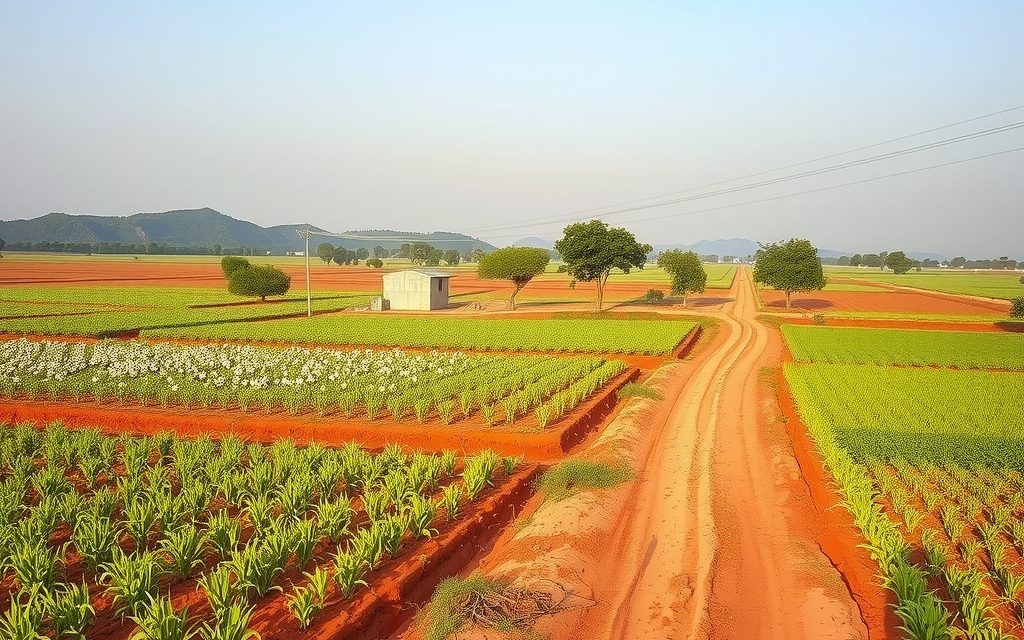
- About 25 km from the ORR's eastern exits, between NH-163 (via Bibinagar) and NH-65 (via Choutuppal); roughly 45 km from Uppal or LB Nagar
- Agricultural land registers at the Bhoodan Pochampally Tahsildar office with mutation in the same step; converted land at the jurisdictional SRO
- About 60% borewell (250–600 ft); Musi-fed canals irrigate lowland paddy, with water-quality caveats
- Red uplands for mango, sapota and guava; darker lowland soils for paddy near the Musi and tanks
- Typical parcels: 1–10 acre family patta holdings; 10–40 gunta farm plots in gated ventures
| What | Indicative range | Note |
|---|---|---|
| Interior uplands, cart-track access, borewell | ₹35 L – ₹65 L per acre | indicative, Oct 2026 |
| Musi-canal or tank-fed paddy land, lowland villages | ₹30 L – ₹60 L per acre | indicative, Oct 2026 |
| Village BT-road frontage, 2–6 km from Pochampally | ₹60 L – ₹1.3 Cr per acre | indicative, Oct 2026 |
| Bibinagar–Choutuppal road frontage and village fringe | ₹1.2 Cr – ₹2.5 Cr per acre | indicative, Oct 2026 |
| Mango or sapota orchard with working borewell | ₹45 L – ₹90 L per acre | indicative, Oct 2026 |
| Farm plots in gated farm ventures | ₹3 L – ₹7 L per gunta | indicative, Oct 2026 |
Ranges reflect recent transactions and advisor observation as of 2026-10. Always verify against the sub-registrar market value and the specific parcel.
Anyone researching agriculture land in Pochampally soon learns that Bhoodan Pochampally is best known for two things that have nothing to do with property prices: the ikat sarees woven on hundreds of handlooms in and around the village, and the morning in April 1951 when a local landowner gifted land to Vinoba Bhave and started the Bhoodan movement. Both still shape the place. The weaving gives Pochampally a living economy and a steady trickle of visitors; the Bhoodan history leaves a legal footprint that every land buyer here needs to understand. Around the village, red uplands carry mango, sapota and guava, low fields along the Musi grow paddy, and a handful of gated farm ventures sell plots to Hyderabad families who want a weekend farm about 25 km beyond the Outer Ring Road. This guide explains how to reach it, what the soil and water are really like, indicative per-acre and per-gunta prices as of October 2026, the title checks that are specific to this mandal, and how registration works at the Bhoodan Pochampally Tahsildar office in Yadadri Bhuvanagiri district, Telangana.
It is aimed at buyers in the eastern half of Hyderabad, from Uppal, Nagole and LB Nagar to Hayathnagar and Pocharam, for whom Pochampally sits closer in driving time than the western farm belts, and at long-term buyers watching the Regional Ring Road's eastern stretch between Bhongir and Choutuppal.
Why Pochampally works for a farm or orchard
Pochampally is not a highway town. It sits between two national highways, NH-163 to the Warangal side and NH-65 to the Vijayawada side, on a district road that links Bibinagar in the north with Choutuppal in the south. That in-between position is the reason it suits farm buyers.
- Countryside without a long drive: most of the mandal is still cultivated, with few industrial sheds and little plotting compared with the highway corridors either side of it.
- Prices below the highway belts: interior land here is typically cheaper per acre than comparable land around Bibinagar, where AIIMS and NH-163 frontage pull values up.
- A village with an identity: the handloom economy, the weekend visitors and the village's international recognition as a tourism village give Pochampally a character that a featureless farm belt lacks. Some buyers value that; others simply appreciate a market town with banks, a hospital and a weekly shandy.
- Two water stories: borewell-fed uplands for orchards and Musi-fed lowlands for paddy, which lets a buyer choose land to suit the plan rather than the other way round.
The cautions are just as specific: Bhoodan and assigned land are common in the mandal's record history, the Musi brings water but also the city's wastewater, and the RRR story is often oversold by sellers. We deal with each below.
Location, roads and distances from Hyderabad
Approximate road distances to Pochampally village. Exact times depend on the hour you leave and which exit you use.
| From | Approximate distance | Typical route and time |
|---|---|---|
| ORR, eastern exits | ~25 km | Ghatkesar exit via NH-163 and Bibinagar, or the NH-65 side via Choutuppal; 35–45 minutes |
| Uppal / Nagole | ~40–45 km | Via Ghatkesar and Bibinagar; about an hour |
| LB Nagar | ~45 km | NH-65 east, then north from the Choutuppal side; about an hour |
| Gachibowli / Hitech City | ~75 km | ORR around the south or north to the eastern exits; 1.5–2 hours |
| Bibinagar | ~15 km | District road south from NH-163 |
| Choutuppal | ~15 km | District road north from NH-65 |
| Bhongir (district HQ) | ~25–30 km | Via Bibinagar or via Valigonda side roads |
The two approach corridors
Buyers from Uppal, Secunderabad and the north-east usually come in from NH-163, turning south at Bibinagar. Buyers from LB Nagar, Vanasthalipuram and Hayathnagar usually take NH-65 and turn north on the Choutuppal side. Because Pochampally sits between the two, a parcel on the northern edge of the mandal and one on the southern edge can feel very different in commute time depending on where in Hyderabad you live. Decide which corridor you will actually use every weekend before you shortlist.
Inside the mandal
Away from the Bibinagar–Choutuppal road, village roads are single-lane black-top or gravel, and many fields are reached by cart tracks across neighbouring land. In the Musi lowlands, some tracks become difficult after heavy rain. Road frontage, even on a modest village road, is one of the biggest price drivers here, and an unrecorded track is one of the commonest causes of later disputes.
The Regional Ring Road
The proposed northern arm of the RRR is planned to end on the eastern side near Choutuppal on NH-65, coming down from the Bhongir side on NH-163. That puts the corridor east and south of Pochampally rather than through its centre, and some villages near the mandal's edges may fall within or close to the alignment. The southern arm, which would start from the same Choutuppal end, remains at an earlier stage. Land inside a notified right-of-way is acquired at compensation rates and does not produce a windfall. Gains, where they come, tend to cluster near interchanges once construction is visible. Ask for the survey number to be checked against the latest notified village list, and treat any seller's "RRR touching" claim as something to verify, not a reason to pay extra. Our Regional Ring Road land guide explains how to read the notifications.
The Bhoodan legacy and what it means for title today
Pochampally's place in history comes from the Bhoodan movement, which began here when a landowner offered roughly 100 acres to Vinoba Bhave for distribution to landless families. The movement spread across India, and donated land in Telangana came under the Bhoodan Yagna Board and the state's Bhoodan and Gramdan law.
For a buyer in 2026 this is not an abstract story. Land that was donated under Bhoodan and allotted to landless families generally cannot be sold freely by the allottee, much like assigned land. Over seven decades some of it has changed hands informally, been inherited, been sold on unregistered agreements or been mixed into neighbouring patta holdings. That is exactly the kind of history that can surface years after you buy.
How we check for Bhoodan and assigned land in Pochampally
- Read the long pahani history, not just the current record. Notes such as Bhoodan, assigned, sarkari, inam or poramboke in older years need an explanation before any advance is paid.
- Trace the earliest available title. We want to see how the seller's family first acquired the land, not just the last two sales.
- Cross-check with the Tahsildar office and, where needed, with Bhoodan Board records for the village.
- Look at the shape of the parcel. Small, regular plots carved out of a larger survey number in a village with a Bhoodan history are a prompt to dig further.
- Check the prohibited properties list under Section 22-A for the survey number, because government-linked lands are blocked from registration.
None of this means Pochampally land is unsafe. Most farm land here is ordinary patta land held by farming families for generations. It means the paperwork has to go deeper than a Bhu Bharati screenshot.
Soil, water and what grows around Pochampally
The soil
Red soil dominates the uplands: well drained, gravelly in places, with sheet rock showing on some ridges. It warms up fast, suits mango, sapota, guava and vegetables, and needs organic matter and drip to hold moisture. Towards the Musi and below village tanks, soils are darker and heavier, which suits paddy. Walk the whole extent before agreeing a price; a two-acre parcel with half an acre of exposed rock is really a one-and-a-half-acre farm.
The water: borewells, tanks and the Musi
Roughly 60% of farmed land around Pochampally relies on borewells, usually somewhere between 250 and 600 feet, with shallower yields in valleys and below tanks and deeper, less reliable water on ridges. About a quarter is rainfed, typically under cotton or maize. A tenth or so gets canal water, and a small share still uses open wells.
The canal water comes from the Musi. The river flows east out of Hyderabad and passes through this part of Yadadri Bhuvanagiri district, where old diversion canals feed paddy and fodder fields in villages towards Pochampally, Bibinagar and Valigonda. Locals often refer to them by the villages they serve. This water is reliable through most of the year because the Musi carries the city's discharge, and that is the problem: a large part of that flow is treated or untreated wastewater from Hyderabad.
The Musi question every buyer should ask
- Musi-irrigated fields can show salt and contamination effects in the soil over time, and crops grown on that water face increasing scrutiny.
- Borewells near the river or the canals can draw on the same water. Get a basic water test, and for any plan involving fruit, vegetables or a family home, a fuller test is worth the cost.
- The state has announced plans to clean up and redevelop the Musi. If those succeed, water quality downstream should improve, but that is a long-term hope, not something to price in.
- For an orchard or weekend home, our preference is an upland parcel on a tested borewell rather than a canal-fed lowland, even if the lowland looks greener in October.
What grows here
Paddy in the canal and tank lowlands, cotton and maize on rainfed uplands, and vegetables wherever a borewell supports them. Mango is the most common orchard crop, followed by sapota and guava; many weekend buyers plant mango on drip with guava or papaya between rows for earlier income. Village tanks, including the large tank near Pochampally itself, recharge borewells around them, and a parcel within sight of a tank that holds water into summer is worth noticeably more than one on a dry ridge.
Indicative price bands: agriculture land in Pochampally and farm plots
These ranges reflect recent transactions and advisor observation as of October 2026. They are indicative only. Approach road, frontage, water, rock cover and title quality can move a parcel to either end of a band or outside it.
| Parcel type | Indicative range | What moves the price |
|---|---|---|
| Interior uplands, cart-track access, borewell | ₹35 L – ₹65 L per acre | Borewell yield, rock cover, track rights |
| Musi-canal or tank-fed paddy land, lowland villages | ₹30 L – ₹60 L per acre | Water quality, drainage, monsoon access |
| Village BT-road frontage, 2–6 km from Pochampally | ₹60 L – ₹1.3 Cr per acre | Road width, frontage length, weekend-farm demand |
| Bibinagar–Choutuppal road frontage and village fringe | ₹1.2 Cr – ₹2.5 Cr per acre | Conversion potential, commercial use, distance to town |
| Mango or sapota orchard with working borewell | ₹45 L – ₹90 L per acre | Tree age and health, drip, fencing |
| Farm plots in gated farm ventures | ₹3 L – ₹7 L per gunta | Plantation, fencing, caretaking, title structure |
Reading the per-gunta numbers
One acre is 40 guntas. A farm plot at ₹5 lakh per gunta works out to ₹2 crore per acre, roughly three times the price of good interior patta land a few kilometres away. A 20-gunta plot at that rate costs ₹1 crore, and the buyer is paying for fencing, a planted orchard, a shared borewell, an internal road and a caretaker. That trade can be sensible for a family that will never run a farm itself, but it should be a deliberate decision, not one made because the brochure only quotes the per-gunta figure.
Also check the government market value for the village before agreeing a price. Duties are charged on the higher of the market value and your actual consideration, and market values in this part of Yadadri Bhuvanagiri are often below transaction prices.
Parcel types you will be offered around Pochampally
Family patta land, one to ten acres
The core of the market. Usually held by a farming family for two or three generations, often jointly among siblings. The value is good; the work lies in getting every co-owner and heir to sign, and in confirming the access route.
Musi-side paddy fields
Flat, productive and easy to lease to a local farmer, but low-lying, water-quality sensitive and not where you want a farm dwelling. Suits buyers who want rental income from cultivation and a long hold.
Upland orchard blocks
Red-soil slopes with or without existing trees. The most popular choice for weekend buyers because they drain well, offer a view and keep a farmhouse dry in the monsoon.
Farm plots in gated farm ventures
Ten to forty gunta units inside a fenced venture, usually with plantation and caretaking. Before buying, read our checklist on managed farmland schemes and what to check. In particular, confirm that your plot is a separately identifiable extent in the sale deed and survey sketch, that the developer owns the internal roads and the approach, and that no villa, clubhouse or resort is being promised on unconverted land.
Land with farmhouse potential
Agricultural land allows farm structures such as a pump house, shed and caretaker's room. A substantial residence generally needs NALA conversion and building permission. If a seller says "farmhouse allowed", ask what exactly has been permitted and by whom.
Pochampally compared with the farm belts either side
| Belt | Why buyers go there | What to weigh |
|---|---|---|
| Pochampally | Quiet, cultivated, between two highways, handloom village character | Bhoodan/assigned history; Musi water quality; slower appreciation |
| Bibinagar | NH-163, AIIMS, closer to the ORR | Higher prices; more plotting pressure near the highway |
| Choutuppal | NH-65, industrial and RRR activity | Industrial neighbours in parts; frontage priced for commercial use |
| Yadadri | Lower per-acre prices, temple-town demand | Longer drive; price spikes near the temple roads |
For the highway alternatives, see farm land in Choutuppal on the NH-65 side and agriculture land around Yadadri further north-east.
Telangana agriculture land legal checklist, applied to Pochampally
The list below is the minimum we work through for any parcel in this mandal. Items that carry extra weight here because of local history are marked.
- Pattadar passbook: the original, in the seller's name, with survey number and extent matching what you are buying.
- Bhu Bharati record of rights: current classification as patta agricultural land, no prohibited or disputed flag, and the extent matching the passbook. Older entries were on dharani.telangana.gov.in; we pull the live record on the day of the advance and again before registration.
- Pahanis and ROR-1B (extra weight): at least the last few decades, read for Bhoodan, assigned, inam, sarkari or poramboke notes and for who actually cultivated the land.
- Encumbrance certificate for 30 years: crop loans from cooperative societies and banks are common; they must be closed before or at registration.
- Link documents and family tree: every sale, partition, gift and succession back to the earliest record available, with all legal heirs signing or releasing.
- Survey number, FMB and sub-division: a licensed surveyor fixes boundaries against the field measurement book sketch. Sub-divisions created only on paper need care.
- Bhoodan and assigned land (extra weight): allotted Bhoodan land and land assigned to landless families cannot be freely sold. Treat any such history as a stop sign until resolved.
- Section 22-A prohibited list: government, endowment, wakf and other listed lands cannot be registered.
- Tank and Musi checks: no part of the parcel inside a tank's full tank level, a stream course or a canal; check canal and river buffers for lowland fields.
- NALA status: agricultural land cannot be used for non-agricultural purposes without conversion. Know which use you are buying.
- Ceiling, ULC and forest checks: no land-ceiling surplus declaration, no forest claim, and urban land ceiling questions only where fringe land once fell under it.
- RRR and road notifications: alignment, interchange and widening notifications for the survey number.
- 58/59 regularisation: this applies to occupied government land in urban areas, not to rural farm land. If a seller produces a 58/59 document for a village parcel, investigate carefully.
Our guides on assigned land and 22-A prohibited properties cover these traps in more detail.
Registration at the Bhoodan Pochampally Tahsildar office and the charges
Unconverted agricultural land registers at the mandal Tahsildar office. The Tahsildar acts as joint sub-registrar under the Bhu Bharati record-of-rights system, and mutation into your name happens in the same process, so you leave with the record updated and a new passbook following. For villages in Bhoodan Pochampally mandal that is the Pochampally Tahsildar office; parcels across the line in Bibinagar, Choutuppal, Valigonda or Narayanpur mandals register at their own Tahsildar offices. If the land has been NALA-converted, or you are buying a plot in an approved layout, registration happens at the jurisdictional Sub-Registrar Office instead, which we confirm from the survey number. Official procedures are published at registration.telangana.gov.in.
| Charge | Approximate rate | Comment |
|---|---|---|
| Stamp duty | ~5.5% | On the higher of market value and consideration |
| Transfer duty | ~1.5% | In gram panchayat areas transfer duty is generally not levied, and the registration fee is higher instead |
| Registration fee | ~0.5% (about 2% where no transfer duty applies) | The overall total stays at roughly 7.5% |
| Mutation, passbook, slot charges | Nominal | Paid through the Bhu Bharati process |
Budget about 7.5% of the market value for duties and fees, and expect us to verify the exact rates on the day you book the slot. The 1% TDS under Section 194-IA on purchases above ₹50 lakh does not apply to rural agricultural land; it applies to converted or urban property. Land near a growing town can sometimes fall outside the income-tax definition of rural agricultural land, so if your parcel is on the fringe, ask a chartered accountant.
A weekend visit: how we walk a Pochampally parcel
- Start early from the eastern ORR exits so you reach the first field before the heat. In summer, 8 am is already warm on red soil.
- See the borewell run for at least 20 minutes and note how quickly the flow drops. Ask the seller for the depth and the year it was drilled.
- Walk to the nearest tank or canal and look at the water. If it is dark or smells, think hard about lowland parcels nearby.
- Drive the approach as if it were August. Ask neighbouring farmers whether the track floods and whose land it crosses.
- Talk to the neighbours. In a village with Bhoodan history, people usually know which fields were donated, assigned or disputed.
- Finish in the village at the handloom park or a weaver's home if the family is along. It is the best part of a Pochampally day out.
Who should buy farm land in Pochampally, and who should not
Good fit
- East Hyderabad families who want a weekend orchard within about an hour of Uppal or LB Nagar.
- Patient land-bank buyers who prefer cultivated countryside to highway speculation, and who will hold for many years.
- Buyers wanting a farm with cultivation income, by leasing paddy land to local farmers.
- People who enjoy the handloom village setting and want to be part of it on weekends.
Better to look elsewhere
- Anyone wanting quick resale gains from RRR news; the corridor sits at the edges of the mandal, and timelines are long.
- Buyers who want a large residence on agricultural land without conversion.
- Anyone unwilling to pay for deeper title work in a village with Bhoodan and assigned land history.
- West Hyderabad residents who will realistically visit only once a quarter because of the drive.
NRI note: Pochampally farm land and FEMA
NRIs and OCIs cannot buy agricultural land, plantation property or farmhouses in India under FEMA rules, and they cannot receive such property as a gift either. A farm plot in a managed venture is still agricultural land, however it is marketed, so the restriction applies to it. NRIs can inherit agricultural land from a person who held it lawfully, continue to own it, and later sell it to a resident Indian. If you are an NRI with family roots in Yadadri Bhuvanagiri, the usual alternatives are approved residential plots or homes in Hyderabad's eastern suburbs. Read our NRI guide to agriculture land rules in Telangana, and take tax advice from a CA before acting on inherited land.
How NRR Estates helps with Pochampally farm land
Our advisory fee is agreed in writing before you commit to anything. In Pochampally our work concentrates on the three things that most often go wrong here: title history, water and access.
- Shortlisting: upland orchard blocks, lowland paddy or venture plots, matched to what you actually plan to do with the land and which corridor you will drive.
- Ground checks: summer borewell runs, basic water tests near the Musi, monsoon access and conversations with neighbouring farmers.
- Title review: long pahani history, Bhoodan and assigned land checks, 30-year EC, link documents, 22-A and RRR notifications, reviewed by an independent advocate.
- Negotiation and registration: agreeing price and terms, booking the Tahsildar slot, attending registration and following mutation through to the passbook.
Comparing with land on the highway side? Our page on farm land around Bhongir covers the district headquarters belt north of here.
Pochampally agriculture land: frequently asked questions
What is the price of agriculture land in Pochampally per acre?
As of October 2026, interior upland farm land around Pochampally with a borewell and cart-track access typically trades at ₹35–65 lakh per acre, based on recent transactions and advisor observation. Musi-canal or tank-fed paddy land is usually ₹30–60 lakh, and parcels with frontage on a village black-top road ₹60 lakh to ₹1.3 crore. Frontage on the Bibinagar–Choutuppal road and land on the village fringe can reach ₹1.2–2.5 crore per acre. These are indicative ranges only; water, access, rock cover and title quality move individual parcels.
How much do farm plots near Pochampally cost per gunta?
Farm plots in gated farm ventures around Pochampally typically ask ₹3–7 lakh per gunta as of October 2026. Since an acre has 40 guntas, ₹5 lakh per gunta equals about ₹2 crore per acre, several times the price of good interior patta land nearby. The premium pays for fencing, plantation, a shared borewell, internal roads and caretaking. Before buying, confirm your plot is a separately identifiable extent in the sale deed and survey sketch, and that nothing beyond farm structures is being promised on unconverted land.
How far is Pochampally from Hyderabad?
Pochampally is roughly 25 km from the Outer Ring Road's eastern exits. From Uppal or Nagole it is about 40–45 km via Ghatkesar and Bibinagar, usually around an hour. From LB Nagar it is about 45 km via NH-65 and the Choutuppal side. From Gachibowli or Hitech City expect around 75 km and 1.5 to 2 hours. Bibinagar and Choutuppal are each about 15 km away, and Bhongir, the district headquarters, roughly 25–30 km. East Hyderabad residents find it a practical weekend-farm distance.
Is Bhoodan land in Pochampally safe to buy?
Land that was donated under the Bhoodan movement and allotted to landless families generally cannot be sold freely by the allottee, much like assigned land, so it is not something to buy. Most farm land in Pochampally is ordinary patta land, but because the Bhoodan movement started here, we read long pahani histories for Bhoodan, assigned, inam or sarkari notes, trace the earliest title, cross-check with the Tahsildar office and Bhoodan records where needed, and check the Section 22-A list before any advance is paid.
Is Musi canal water good for farming in Pochampally?
Musi-fed canals keep lowland paddy and fodder fields green for most of the year, but much of the river's flow is treated or untreated wastewater from Hyderabad. Over time this can affect soils, and produce grown on it faces growing scrutiny. Borewells close to the river or canals may draw on the same water. For an orchard or weekend home we prefer an upland parcel on a tested borewell. If you buy lowland land, get a water test and treat the state's Musi clean-up plans as a long-term hope.
Will the Regional Ring Road pass through Pochampally?
The proposed northern arm of the Regional Ring Road comes down from the Bhongir side towards Choutuppal on NH-65, so the corridor runs east and south of Pochampally rather than through its centre. Some villages near the mandal's edges may lie within or close to the alignment. Land inside the right-of-way is acquired at compensation rates. Gains usually cluster near interchanges once construction is visible. Check the survey number against the latest notified village list and do not pay a premium for unverified RRR claims.
Where is farm land in Pochampally registered and what does it cost?
Unconverted agricultural land registers at the Bhoodan Pochampally Tahsildar office, where the Tahsildar acts as joint sub-registrar under Bhu Bharati and mutation happens in the same process. Converted land and approved-layout plots register at the jurisdictional Sub-Registrar Office, which we confirm from the survey number. Budget roughly 7.5% of the market value: about 5.5% stamp duty, 1.5% transfer duty and 0.5% registration fee, with a higher registration fee instead of transfer duty in gram panchayat areas. We verify current rates on the day.
Can NRIs buy farm land or farm plots in Pochampally?
No. Under FEMA, NRIs and OCIs cannot purchase agricultural land, plantation property or farmhouses in India, and cannot receive them as a gift. Farm plots in managed ventures are agricultural land, so the rule applies to them too. NRIs can inherit agricultural land from someone who held it lawfully, keep it, and sell it later to a resident Indian. NRIs who want property in this part of Telangana usually look at approved residential plots or homes in east Hyderabad instead. Take tax advice from a CA.
Related guides
The closest affordable farm belt east of the ORR, now shaped by AIIMS Bibinagar. Indicative per-acre prices, the Musi water question, HMDA zoning and the Bhoodan and assigned-land checks this belt needs.
Farm land on the Vijayawada highway where the planned RRR meets NH-65, about 28–30 km past the ORR. Highway frontage and interior paddy or cotton land are separate markets with very different prices and checks.
Temple-town fringe land, tank-fed paddy and red-soil orchard parcels around Yadagirigutta on NH-163. Indicative per-acre prices, water reality, the RRR north outlook and the endowment-land checks this belt demands.
Farm land around the Bhongir fort town on NH-163, 30–35 km past the ORR. Village-by-village guide, honest water and Baswapur canal picture, RRR context, indicative per-acre prices and the title checks this district needs.
Bibinagar, 17–20 km past the ORR on the Warangal highway, is the AIIMS town of the eastern corridor. HMDA plot bands by distance from the campus, rental-build realities, water-line checks and how it compares with Bhongir.
The RRR is the biggest land story around Hyderabad and the most misunderstood. This guide separates the northern and southern arms, explains acquisition and compensation, and shows how far from the alignment buyers should actually be.

NRIs and OCIs cannot buy or receive gifts of agricultural land, plantations or farmhouses; inheritance is the only route. What inherited land allows, why benami workarounds are dangerous, and the lawful alternatives near Hyderabad.
Red-soil farmland 4 km from the ORR beside the Aerospace SEZ and TCS campus. Interior villages still farm vegetables and mango; land near the SEZ is priced as future layout land and needs careful acquisition checks.