Agriculture & Farm Land in Gandipet, Hyderabad
Red-soil acreage, orchards and farmhouse estates around Osman Sagar, minutes from Kokapet. What the GO 111 repeal changed, indicative per-acre bands, lake FTL risks and how registration works.
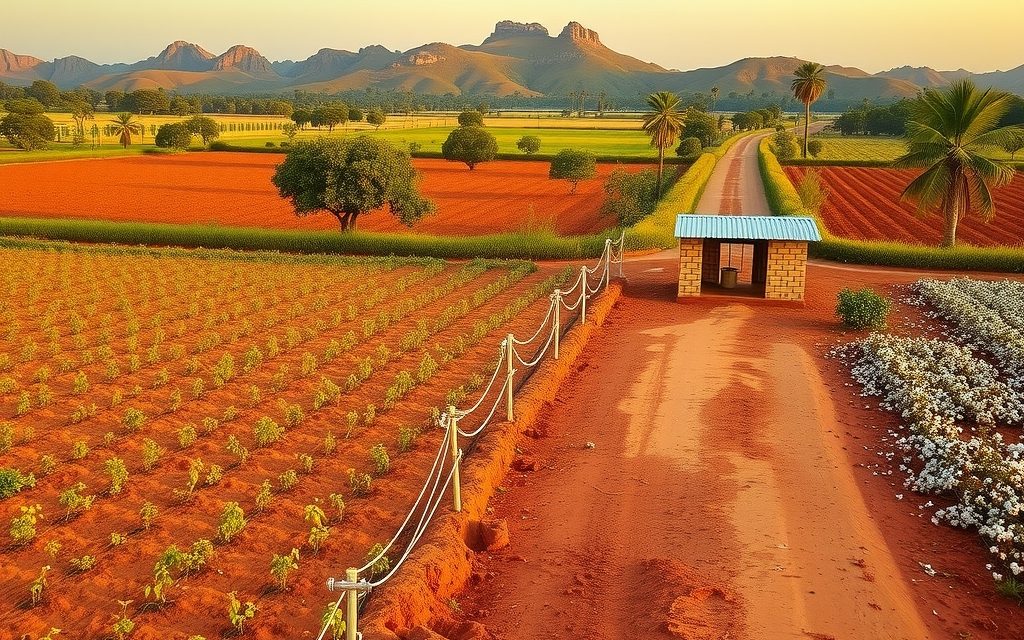
- Lake belt 5–7 km from the Kokapet ORR interchange; 20–35 min to the Financial District
- Agricultural land registers at the Gandipet Tahsildar (or Moinabad/Shankarpally by village); converted land at the Gandipet SRO
- Borewells typically 400–1,000 ft; Osman Sagar itself is not an irrigation source
- Red sandy and gravelly loam over granite boulders; mango, guava, sapota and custard apple
- Parcels from 5–20 gunta farm-villa units to 2–10 acre farmhouse estates; 1–5 acres most traded
| What | Indicative range | Note |
|---|---|---|
| Patta farm land, 1–5 acres, outer catchment villages | ₹3.5 Cr – ₹8 Cr per acre | indicative, Oct 2026 |
| Agricultural land close to the Kokapet / Narsingi edge | ₹12 Cr – ₹25 Cr per acre | indicative, Oct 2026; zoning-dependent |
| Frontage on Gandipet main road or Shankarpally road | ₹10 Cr – ₹22 Cr per acre | indicative, Oct 2026 |
| Older farmhouse estates, 2–10 acres, with structures | ₹5 Cr – ₹12 Cr per acre | indicative, Oct 2026; verify structure permissions |
| Units in gated farm-villa ventures | ₹20 L – ₹45 L per gunta | indicative, Oct 2026; check title structure |
Ranges reflect recent transactions and advisor observation as of 2026-10. Always verify against the sub-registrar market value and the specific parcel.
Gandipet is the name most of Hyderabad still uses for Osman Sagar, the reservoir the Nizam's engineers built on the Musi in the 1920s after the great flood of 1908. The villages ringing the lake on the city's western edge, in Gandipet mandal of Rangareddy district and the neighbouring Moinabad and Shankarpally mandals, spent more than 25 years frozen under GO 111, the 1996 order that kept the reservoir catchment largely agricultural. If you are looking at agriculture land in Gandipet today, you are buying into the most argued-over farm belt in Telangana: land that sits 15 minutes from the Neopolis towers at Kokapet, yet still carries red-soil fields, mango groves, granite boulders and some of the city's oldest weekend farmhouses.
This guide is written for buyers who want to understand what they are actually purchasing. We explain what the repeal of GO 111 did and did not change, how genuine patta farm land differs from the "farm-villa plots" advertised along the lake roads, indicative per-acre and per-gunta price bands as of October 2026, the water and soil you can expect, the legal checks that matter more here than almost anywhere else, and how registration works at the Gandipet Tahsildar office and the Gandipet sub-registrar office. Prices and observations come from recent transactions and advisor observation, not from listing portals.
Why agriculture land in Gandipet attracts serious money
Three forces meet around the Osman Sagar shoreline. The first is proximity. The lake's eastern edge is barely 4 to 6 km from the Kokapet and Narsingi interchanges on the Outer Ring Road, and the Financial District is typically 20 to 30 minutes away outside the evening peak. No other farm belt with real acreage, open fields and lake views sits this close to the city's highest-paying employment cluster.
The second is scarcity created by regulation. For more than two decades GO 111 restricted most built development in the catchment villages of Osman Sagar and Himayat Sagar. While Kokapet, Narsingi and Tellapur filled with towers, the land on the other side of the line stayed in fields and farmhouses. That held prices down for years and left a large stock of agricultural acreage right next to the city, which is exactly what makes the belt so contested now.
The third is expectation. When the state withdrew GO 111 in 2022, the market began to price in the possibility of future conversion. Some of that expectation is reasonable and some is speculation. A buyer who understands the difference, survey number by survey number, can still buy well here. A buyer who believes every acre near the lake will become a villa layout next year is likely to overpay.
What Gandipet is not is cheap farming land. If you want acreage to cultivate at an agricultural price, you will get far more land for your money in the villages covered on our page on farm land in Moinabad or further west toward Chevella.
Gandipet farm-land market snapshot, October 2026
- Who is buying: senior IT and pharma professionals from the Financial District and Kokapet, business families from Jubilee Hills and Banjara Hills, and developers quietly assembling land banks.
- What trades: 1 to 5 acre patta parcels in the catchment villages, older farmhouse estates on 2 to 10 acres, and gated "farm-villa" ventures selling 5 to 20 gunta units.
- Supply: moderate in the outer catchment villages, very thin near the Kokapet and Narsingi edge where most land has already been absorbed.
- Price direction: firm but uneven. Parcels with clear zoning and good approach roads have held value; parcels with FTL, buffer or title questions have become harder to sell.
- Biggest risk: paying a conversion price for land that remains restricted, sits in the reservoir's full tank level or buffer, or has a weak title chain.
GO 111 and its repeal: what changed for farm-land buyers
GO 111 was issued in March 1996 to protect the two reservoirs that once supplied most of Hyderabad's drinking water. It covered a radius of roughly 10 km from the full tank level of Osman Sagar and Himayat Sagar, touching around 84 villages. Within that zone it barred polluting industries, large hotels and residential layouts, and it treated the bulk of the land as conservation and agricultural use, with only very limited built-up area permitted on individual holdings. In practice that kept the catchment green and depressed land values compared with the neighbouring corridor.
In April 2022 the state government withdrew GO 111 through a fresh order (GO 69) and said new regulations would be framed to protect the lakes by other means, such as sewage treatment, drainage diversion and green zones. That single change triggered a wave of buying. The catch is that withdrawing the old order is not the same as rezoning every survey number for housing. Land use is still governed by the HMDA master plan, by the rules that follow the withdrawal, by lake protection norms and by the outcome of litigation and environmental challenges.
For a buyer in October 2026 that means four practical things:
- Check the land use, not the headline. Pull the master plan zoning for the exact survey number. Agricultural, conservation and water-body buffer zonings still exist in the catchment, and they decide what you can build.
- Do not assume a building permission. A farmhouse or villa needs NALA conversion and building permission from the competent authority. Neither is automatic, and conditions in the catchment can be stricter than elsewhere.
- Read the court position. Environmental challenges to the withdrawal and related orders have been argued in court. Ask your advocate to confirm the current status before you pay a conversion premium.
- Price the downside. If the land stays agricultural for another decade, are you comfortable with what you paid? If the answer is no, the price is too high.
Our longer explainer on the GO 111 repeal covers the history in detail. For a farm buyer the summary is simple: the repeal widened the possibilities, but it did not remove the need to verify every parcel.
Location, access and connectivity around Osman Sagar
Gandipet is less a single village than a belt. The lake's eastern shore faces Kokapet, Narsingi and Manchirevula; the northern side runs along the Gandipet main road past the CBIT engineering campus toward Janwada and Mokila; the southern and western catchment spreads into Moinabad and Shankarpally mandals. How you approach the land depends on which side of the reservoir it sits.
From the Kokapet and Narsingi interchanges
Most site visits start from the ORR at Kokapet or Narsingi. From there the Gandipet main road climbs past the Kokapet edge and the CBIT campus toward the lake. Traffic is heavy at college hours and in the evening when Neopolis empties, so morning visits work best.
From Manchirevula and the Himayat Nagar side
A second approach runs from Manchirevula and the Himayat Sagar side toward the southern shore. The roads are narrower, pass farmhouse walls and orchards, and are useful if you are comparing Gandipet acreage with parcels toward Chilkur and Moinabad on the same day.
From the Mokila and Shankarpally side
Buyers coming from Tellapur or Kollur can reach the northern catchment through Mokila and Janwada. This side of the lake is quieter and greener, and it sits closer to the farm belt we describe on our page on agriculture land in Mokila.
Distances at a glance
| From the Gandipet lakefront (CBIT side) to | Approx. distance | Typical drive |
|---|---|---|
| Kokapet ORR interchange | 5–7 km | 12–20 min |
| Financial District / Wipro Circle | 10–13 km | 20–35 min |
| Gachibowli / Hitech City | 15–19 km | 30–50 min |
| Mokila Junction | 10–12 km | 20–30 min |
| Moinabad and Chilkur | 12–16 km | 25–35 min |
| RGIA, Shamshabad (via ORR) | 30–35 km | 35–50 min |
The proposed Regional Ring Road runs far to the west and south of the lake and is not a direct driver here. Gandipet's value comes from the ORR and the Kokapet employment cluster, not from the RRR, so be wary of any seller who leans on the regional road to justify a price.
Soil, water and what grows in the Gandipet catchment
Soil and terrain
The catchment is classic Deccan granite country: rolling ground, exposed boulder clusters, red sandy and gravelly loam on the slopes and somewhat deeper, darker soil in the hollows where water collects. Topsoil can be generous in one field and a few inches over sheet rock in the next. The boulders that make the landscape beautiful also make levelling, fencing and borewell drilling more expensive, so walk the full parcel and dig test pits before you agree a price.
Water
Osman Sagar itself is not an irrigation source for private farms. The reservoir is protected, and drawing water from it or its feeder streams is not something you should plan on. Farms here run on borewells, a few surviving open wells and the monsoon. Bore depths have increased steadily as the surrounding area has built up; recent bores in the belt typically go 400 to 1,000 feet, and yield varies sharply between neighbouring survey numbers because water moves through fractures in the granite.
On every site visit, ask for the depth and drilling year of each bore, run the pump for at least 30 minutes, and confirm that the agricultural power connection is in the seller's name and transferable. For larger purchases, a hydrogeologist's survey costs a tiny fraction of the land price and can save you from a dry acre.
Crops and orchards
The working farms grow mango (mostly Banganapalli with some Himayat and Dasheri), guava, sapota, custard apple on the thinner rocky soils, coconut around farmhouses, and vegetables, fodder and flowers where water allows. Paddy appears only in a few low-lying patches. For most buyers the realistic pattern is a drip-irrigated mango or guava orchard with a caretaker, which keeps the land in genuine agricultural use and supports your records if questions are ever asked about how the land is used.
Indicative price bands for agriculture land in Gandipet
The ranges below are indicative, drawn from recent transactions and advisor observation as of October 2026. They are not quotes or offers. Zoning, approach road, frontage, distance from the lake's protected margin, water and title quality can move an individual parcel well outside these bands.
| Parcel type | Indicative range | What moves the price |
|---|---|---|
| Patta farm land, 1–5 acres, outer catchment villages | ₹3.5 Cr – ₹8 Cr per acre | Approach road width, master-plan land use, borewell yield |
| Agricultural land close to the Kokapet and Narsingi edge | ₹12 Cr – ₹25 Cr per acre | Conversion potential, frontage, distance from the ORR |
| Parcels with frontage on the Gandipet main road or Shankarpally road | ₹10 Cr – ₹22 Cr per acre | Frontage length, road-widening line, zoning |
| Older farmhouse estates, 2–10 acres, with structures | ₹5 Cr – ₹12 Cr per acre | Legality of existing structures, trees, water, privacy |
| Units in gated farm-villa ventures | ₹20 L – ₹45 L per gunta | Title structure, layout status, amenities promised |
One gunta is about 121 square yards, so a 10-gunta farm-villa unit at ₹30 lakh per gunta costs roughly ₹3 crore, which is close to what an approved plot of similar size costs in some HMDA layouts on the other side of the ORR. If you are paying approved-plot money, make sure you are getting approved-plot certainty. Compare these numbers with open plots in Kokapet before deciding which route suits you.
Farm land versus farm-villa plots: know which one you are buying
Around Gandipet two very different products are sold with similar words, and confusing them is the most expensive mistake we see.
Patta farm land
This is agricultural land held under a pattadar passbook and recorded in the state's land records portal, bought by survey number and sub-division, registered at the Tahsildar office and mutated into your name in the same step. You own a defined piece of agricultural land. What you can build on it depends on zoning and conversion. It is the cleanest product legally, provided the title chain and the land record are clean.
Farm-villa plots in gated ventures
These are ventures where a developer buys a larger agricultural parcel, fences it, lays internal roads and sells smaller units, often marketed with a clubhouse and a promise that you can build a "farm villa". The legal structure varies widely. Some sell sub-divided survey numbers registered as agricultural land; some sell undivided shares; some have sought conversion and layout approval; many have not. Inside the HMDA area, sub-dividing agricultural land into small plots without layout approval can be treated as an unauthorised layout, and the right to build a house on a 10-gunta agricultural unit is not automatic.
Before buying a farm-villa unit, we check the developer's own title, whether a layout approval or conversion exists and for what extent, whether your unit can be separately mutated, what the master plan says about the mother survey number, and whether any structure already built in the venture has building permission. If those answers are vague, the risk sits with you, not the developer.
Farmhouse estates
Older walled estates with a house, trees and a borewell are the third product. They appeal to families who want something ready. The question here is whether the existing structures were legally permitted and whether any part of the estate falls within the lake's protected margin. A beautiful house built without permission is a liability, not an asset.
Lake FTL, buffer zones and HYDRAA: the Gandipet-specific risk
The single biggest legal risk around Osman Sagar is land that falls within the reservoir's full tank level (FTL) or the buffer zone around it. FTL land can never be built on and buffer land carries heavy restrictions, whatever the passbook says. In 2024 the state's new agency for protecting lakes and public assets, HYDRAA, began demolishing structures in the FTL and buffer zones of lakes across the city, including around Osman Sagar and Himayat Sagar. Several farmhouse owners who had bought in good faith discovered that their land, or part of it, sat inside the protected line.
Our checks for any parcel near the lake or a feeder stream include the lake's notified FTL boundary, the irrigation department's records, the buffer width that applies, nala and stream alignments crossing the land, and the master plan's water-body designation. We overlay these on the survey map rather than relying on a seller's assurance that "the water never comes this far". Reservoir levels vary year to year; the legal line does not.
Legal checklist for agriculture land in Telangana, applied to Gandipet
- Pattadar passbook: the seller's current passbook, matching the survey number, extent and name exactly.
- Record of rights online: verify the parcel on dharani.telangana.gov.in, which now leads to the Bhu Bharati record of rights, and confirm the land is shown as patta and not under any prohibited or disputed category.
- 1B and pahani: the 1B record of rights extract and pahani entries for past years show ownership and cultivation history; gaps or sudden changes need explanation.
- Encumbrance certificate for 30 years: to catch mortgages, prior sales and attachments.
- Link documents: every sale deed, partition, gift or succession document in the chain, ideally back to the original grant.
- Survey number and FMB: the field measurement book sketch and a fresh survey by a licensed surveyor so that boundaries on the ground match the records.
- NALA status: whether the land is still agricultural or has been converted, and for what extent.
- Section 22-A prohibited properties list: government, endowment, wakf and other lands that cannot be registered.
- Assigned land caution: land assigned by the government to landless families cannot legally be sold; around the lake, some old assignments have been "sold" informally for decades.
- 58/59 regularisation: if any part of the chain involves land regularised under GO 58 or GO 59, read the conditions carefully.
- Forest, ceiling and ULC checks: confirm the land was not declared surplus under land ceiling or urban land ceiling laws, and does not adjoin notified forest.
- Catchment and lake checks: master plan land use, FTL and buffer, nala alignment, and any conditions flowing from the GO 111 withdrawal and later regulations.
Registration in Gandipet: Tahsildar, Gandipet SRO and charges
Unconverted agricultural land registers at the mandal Tahsildar office, where the Tahsildar acts as joint sub-registrar under the integrated land records system and mutation into the buyer's name happens in the same step. For land in Gandipet mandal that means the Gandipet Tahsildar. Some villages in the western and southern catchment fall in Shankarpally or Moinabad mandals instead, and those parcels register with that mandal's Tahsildar, which we confirm from the survey number. NALA-converted land and non-agricultural plots register at the jurisdictional sub-registrar office, which for most of this belt is the Gandipet SRO.
| Charge | Approximate rate | Note |
|---|---|---|
| Stamp duty | ~5.5% of market value | On the higher of agreed price or government value |
| Transfer duty | ~1.5% | Collected with stamp duty |
| Registration fee | ~0.5% | Rates verified on the day |
| Total (indicative) | ~7.5% | Plus surveyor, advocate and advisory fees |
Rates and procedures change, so we verify them on the day and on registration.telangana.gov.in. The 1% TDS under Section 194-IA does not apply to rural agricultural land, but it does apply to converted or urban property above ₹50 lakh. Whether a particular parcel counts as rural agricultural land for income-tax purposes depends on its distance from municipal limits, and around Gandipet that question needs a CA's view.
Who should buy agriculture land in Gandipet, and who should not
Good fit
- Long-horizon land bankers with 10 years or more, who have verified zoning and are comfortable if conversion takes longer than expected.
- Families wanting a working weekend farm within half an hour of the Financial District, with the patience to manage water and a caretaker.
- Buyers of established farmhouse estates where the existing structures have been verified as legal and the estate is clear of FTL and buffer.
Poor fit
- Anyone who needs bank finance; most lenders do not fund agricultural land purchases.
- Short-term flippers betting on an immediate rezoning.
- Buyers who want to build a villa within a year; an approved plot or a ready villa is a better route, and our page on villas in Kokapet covers that option.
- Anyone uncomfortable with the possibility that regulations in the catchment tighten again.
A note for NRIs and OCIs interested in Gandipet
Under FEMA, NRIs and OCI cardholders cannot buy agricultural land, plantation property or farmhouses anywhere in India, and they cannot receive such land as a gift. That rules out patta farm land, farmhouse estates and farm-villa units registered as agricultural land in Gandipet. NRIs can inherit agricultural land from a relative, and they may sell inherited farm land only to a resident Indian.
The workable alternatives are open plots in approved non-agricultural layouts, villas and apartments in Kokapet, Narsingi and the surrounding corridor, funded through NRE or NRO accounts. Our guide to NRI rules for agriculture land in Telangana explains inheritance and sale in detail. Never let a relative hold farm land "on your behalf"; it creates benami, tax and succession problems that are expensive to unwind.
How NRR Estates helps you buy farm land around Gandipet
- Shortlisting by survey number: we check zoning, FTL and buffer before you visit, so you only walk land worth walking.
- Site visits: boundary walk, borewell test, approach road check and a frank read on the neighbourhood.
- Document verification: passbook, Bhu Bharati record, 1B, pahani, 30-year EC, link documents and FMB, with an advocate's title opinion.
- Negotiation: we benchmark against recent transactions and tell you when a price assumes a conversion that is not yet real.
- Registration and mutation: slot booking at the Gandipet Tahsildar or the correct mandal, document preparation and follow-up until the passbook is in your name.
Our fees are disclosed in writing before you commit to anything. If you are also weighing land a little further out, our page on agriculture land in Narsingi covers the remaining farm parcels on the eastern side of the lake.
Gandipet farm land: questions buyers ask us
What is the price of agriculture land in Gandipet per acre?
As of October 2026, patta farm land in the outer catchment villages around Osman Sagar typically trades between ₹3.5 crore and ₹8 crore per acre. Parcels close to the Kokapet and Narsingi edge, where conversion potential is higher, range from roughly ₹12 crore to ₹25 crore per acre, and main-road frontage sits around ₹10 crore to ₹22 crore. These are indicative ranges from recent transactions and advisor observation, not quotes. Zoning, FTL and buffer status, approach road, water and title quality can push a specific parcel well outside these bands.
Has the GO 111 repeal made all Gandipet land buildable?
No. In April 2022 the state withdrew GO 111 and said fresh regulations would protect the reservoirs through other means. Withdrawing the order did not rezone every survey number for housing. Land use is still governed by the HMDA master plan, the regulations that follow the withdrawal, lake FTL and buffer rules, and the outcome of legal challenges. Some parcels remain agricultural or conservation zoned. Before paying a premium for conversion potential, we check the land use of the exact survey number and ask an advocate to confirm the current regulatory and court position.
What is the difference between farm land and farm-villa plots in Gandipet?
Patta farm land is agricultural land bought by survey number, registered at the Tahsildar office and mutated into your name. Farm-villa plots are units carved out of a larger agricultural parcel by a developer and sold with internal roads and amenities. Their legal structure varies: sub-divided survey numbers, undivided shares, or converted layouts. Inside the HMDA area, selling small agricultural units as plots without layout approval can be treated as an unauthorised layout, and building a house on them is not automatic. Check the developer's title, approvals and mutation path before paying.
How do I check if Gandipet land is inside the Osman Sagar FTL or buffer?
Ask for the notified full tank level boundary of the reservoir and overlay it on the survey map of the parcel, along with the buffer width that applies and any nala or stream crossing the land. The irrigation department's records and the HMDA master plan's water-body designation are the reference points, not the seller's memory of where the water reaches. Since 2024 HYDRAA has demolished structures within lake FTL and buffer zones, including around Osman Sagar. We do this overlay for every parcel near the lake before a buyer pays any advance.
Where is agricultural land in Gandipet registered?
Unconverted agricultural land registers at the mandal Tahsildar office, where the Tahsildar acts as joint sub-registrar and mutation happens in the same step. For most of the belt that is the Gandipet Tahsildar, but some catchment villages fall in Moinabad or Shankarpally mandals, which we confirm from the survey number. NALA-converted land and plots register at the jurisdictional SRO, typically the Gandipet SRO. Charges are approximately 5.5% stamp duty, 1.5% transfer duty and 0.5% registration fee, about 7.5% in total, verified on the day.
How deep are borewells around Gandipet?
Recent borewells in the Gandipet catchment have typically gone 400 to 1,000 feet, and yields vary sharply between neighbouring survey numbers because groundwater moves through fractures in the granite. Construction across Kokapet and Narsingi has pushed water tables down over the years. The reservoir itself is protected and is not a source you can plan to draw from. On a visit, ask for each bore's depth and drilling year, run it for at least half an hour, and confirm the agricultural power connection. For larger buys, commission a hydrogeologist's survey first.
Can NRIs buy farm land or farm-villa plots in Gandipet?
No. Under FEMA, NRIs and OCI cardholders cannot purchase agricultural land, plantation property or farmhouses, and cannot receive them as a gift. That covers patta land, farmhouse estates and farm-villa units registered as agricultural land around Gandipet. NRIs can inherit agricultural land and may sell inherited farm land only to a resident Indian. The practical alternatives are approved non-agricultural open plots, villas and apartments in Kokapet and Narsingi, funded through NRE or NRO accounts. Avoid nominee arrangements where a relative holds farm land for you.
Is Gandipet farm land a good long-term investment?
It can be for a buyer with a 10-year horizon who has verified zoning, FTL and title, and who would still be comfortable if the land stays agricultural longer than expected. The belt sits beside the Kokapet employment cluster with limited supply, which supports values. The risks are regulatory uncertainty in the catchment, prices that already assume conversion, transaction costs around 7.5% plus fees, and slow resale of large tickets. It is a poor fit for short-term flipping or for buyers relying on bank loans. We compare it with Moinabad and Mokila before advising.
Related guides
The last patta parcels between the Narsingi interchange, Manchirevula and the Musi. How to tell genuine farm land from development land, indicative per-acre bands, JDA basics and the checks that matter here.
The last private agricultural pockets in Kokapet, between Neopolis, the old village and the Gandipet slopes. Indicative per-acre bands, why auction prices mislead, land-bank break-even maths and title checks.
Kokapet's plots sit beside the Neopolis towers and the ORR, minutes from the Financial District. Indicative rates, HMDA versus GP approvals, legal checks and registration costs for buyers and NRIs.
Kokapet is the closest point to the Financial District where gated villa communities still exist. Expect tight supply, land-led pricing from about ₹6 crore, and careful title and approval checks.
Narsingi sits on the ORR between Kokapet and Manikonda, 10–20 minutes from the Financial District. Villa stock is limited and varied, from gated communities to older independent houses priced on land.
Hyderabad's closest established farmhouse belt, 10 minutes past the ORR at Himayat Sagar. Orchards, managed farm plots and estates, with the former GO 111 catchment rules explained.
Red-soil patta land and orchards 8 km past the Kollur ORR exit, priced as a land bank on Hyderabad's western IT corridor. Indicative per-acre bands, water, zoning and the full legal checklist.

NRIs and OCIs cannot buy or receive gifts of agricultural land, plantations or farmhouses; inheritance is the only route. What inherited land allows, why benami workarounds are dangerous, and the lawful alternatives near Hyderabad.